
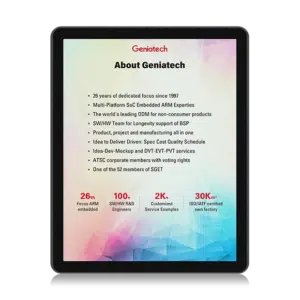
Color e-paper, also known as color electronic paper display (EPD), represents a breakthrough in low-power, high-visibility screen technology. Unlike traditional LCD or OLED displays, color epaper mimics the appearance of ink on paper, offering a reflective display that is easy to read under direct sunlight and consumes minimal energy. This makes it an ideal choice for devices where battery life and readability are critical.
The technology behind color e-paper relies on microcapsules or pixels filled with charged pigments that rearrange to display text and images. Advanced color e-paper panels utilize techniques like color filter arrays or multi-pigment microcapsules to produce vibrant and accurate colors, making them suitable for applications that require more than just monochrome displays.
One of the main advantages of color e-paper is its ultra-low power consumption. Since the display only uses energy when updating content, devices such as e-readers, smart labels, electronic signage, and wearable devices can operate for weeks or even months on a single charge. Additionally, its reflective nature reduces eye strain, making it more comfortable for prolonged reading compared to backlit screens.
Color e-paper is increasingly being adopted in retail, transportation, and industrial applications. For example, electronic shelf labels can display prices and product information in full color, while digital signage and smart cards can show dynamic content efficiently.
Color E Ink Display: Revolutionizing Visual Technology
A color e ink display is an advanced type of electronic paper technology designed to deliver vivid visuals while maintaining the energy-efficient characteristics of traditional E Ink screens. Unlike conventional displays, which rely on constant backlighting, E Ink displays are reflective, using ambient light to make images and text visible. This not only reduces eye strain but also significantly lowers power consumption, making them ideal for devices where battery life is a priority.
Color E Ink technology works by incorporating multiple pigments or color filters into the microcapsules of the display. Each microcapsule contains charged particles that respond to electrical signals, allowing precise control over the color and position of each pixel. Modern color E Ink displays can produce thousands of colors, enabling clear, high-quality images, graphics, and even dynamic content in a low-power format.
The benefits of color E Ink displays extend across multiple industries. E-readers with color capability can render magazines, comics, and educational materials in full color, improving the reading experience. Retail applications, such as electronic shelf labels, can display product information, pricing, and promotions with enhanced visual appeal. Additionally, color E Ink is gaining traction in smart signage, wearable devices, and industrial applications where readability under sunlight and minimal power usage are critical.
AI Accelerator Cards & Modules: Boosting Performance for Intelligent Computing
AI accelerator cards and modules are specialized hardware solutions designed to handle the demanding computational requirements of artificial intelligence workloads. Unlike traditional CPUs, AI Accelerator Cards & Modules devices are optimized for tasks such as deep learning, neural network processing, and machine learning inference, delivering high performance while improving efficiency and reducing latency.
AI accelerator cards are typically installed in desktops, servers, or data center systems through standard interfaces like PCIe. They contain dedicated processors such as GPUs, TPUs, or FPGAs, which allow parallel processing of large datasets. This capability makes them ideal for applications including image and speech recognition, autonomous vehicles, predictive analytics, and complex simulations. By offloading AI-specific workloads from the main CPU, these cards enhance overall system performance and accelerate the deployment of AI-driven solutions.
AI accelerator modules, on the other hand, offer a compact and flexible alternative. These modules are designed for embedded and edge computing applications where space, power efficiency, and real-time processing are critical. Available in form factors like M.2 or COM, AI modules integrate neural processing units (NPUs) or other AI-dedicated processors directly onto a small board. This allows developers to add high-performance AI capabilities to existing systems without redesigning the hardware.
Both AI accelerator cards and modules provide energy-efficient computing, enabling devices to handle intensive AI tasks while minimizing power consumption. They are often supported by software frameworks and development tools that simplify model deployment and optimize performance per watt.
